Literature In Los Angeles

Archive for 2012|Yearly archive page

JAMES

In LITERARY FICTION on November 13, 2012 at 12:26 pm

Short story by Liliana Isella.

“Fredda. Come la sua tomba.”
For the last ten minutes. Over and over. Sexier and sexier.
Cold. As his tomb. That’s what it means.

Really?!? Who’s the idiot who wrote this line? Who’s the marketing big shot who bought this shit? Who’s the dummy who’s gonna drink it?

I was picked for the Italian version of this commercial. It’s a new beer. A light one. She is cheering on the tomb of her ex. Cheating ex? I suppose so. Don’t really know.
Well, there’s not much to know anyways. It’s just the beer, the tomb and me.
High heels, red lips and allusive nonsense.

Thank God, it’s done. The hipster teddy bears on the other side of the cameras give me the thumbs up.
As I close the door behind, Melanie reminds me that we’ll be finished in six days. Five after Halloween.

9000 Sunset Boulevard. Los Angeles from the top floor.
I wait for the elevator and can’t wait for the rest to come.
You get this two star town, you get the five star world.

The sliding doors ring. I stare into the hollow they disclose for me.
Him. Him. Him him him.
James. The million dollar pen. The million dollar liar.
The hero. The coward. The father.
The addict. The husband. The Husband.

I drive a few blocks down. Up and down this boulevard of the moon sun. This kingdom of the rock’n’roll nights. This skyless freedom each day harder to dream about.

I turn left into the Starbucks little lot. So little there’s no space.
Well, I’ll park in one of the Hollywood TV’s. I’m Hollywood enough to not be towed, after all.

I sit outside with my latte. The little patio is right across from James’ hotel.
Room 505.
He tried to convince me. On the phone. Last night.
Should I. Should I not. Should I. Should I not.

I was never able to forget her.
Lilly. Lilly. Lilly Lilly Lilly.
James’ muse, his violated Juliet, his million dollar angel.
I desperately fell in love with her in his first book. I missed her to death in the second. Ever after, she’s been following me around.

I take a sip and wonder if she approves James’ wife. His kids. His Manhattan installation.
Probably not. Not really. Schools, meetings, travels, The Hamptons, family, reunions. She chose not to choose those words.
She chose badass. She chose love. She chose sweet boy.
She chose bye.
Her wrists. A cut. Bye.
Bye sweet boy, bye….

Here. Now. She is.
Lilly.
Long black hair, pale soft skin, big blue eyes.
Full red lips. Immaculate heart. Invincible will.

Second, third, fifth floor.
The Sunset Tower.
The golden doors. The ancient walls. The seductive palms.
James. There, he is.

I just look. Look and hold. My latte.
Look and don’t turn.
Don’t. Turn. To her.

I whisper I want to love him.
I want to love him the way she couldn’t.
Love him. Hold him. Heal him.

She grabs my wrist. Empties my hands. Takes my life.
Red. My beats. Into her soul.
Big. Blue. Soul.

-Liliana. Lilly. Lillian… whatever.
I choke. The guy laughs.
-What a sublime, unique name.
-Well… it’s not that unique, around here. Believe me….
-Oh, in Hollywood, you can never be.
Tattoos all over, black nails and a brand new BMW by the patio’s fence.
-Is this your latte, Liliana?
-Ha… sorry. I don’t know how it got that far.
He places it back on my table and sits down.
-Do you often talk by yourself, Lillian?
Laugh. I do.
-I was just… rehearsing. Let’s say.
-Oh, another actress….
-Kind of. Not really. I mean… commercials, so far. Beers, tombs… stuff like that.
Laugh. He does.
Stand up. I do.
-Ok… gotta go…. Happy Halloween, ok?
Three steps.
To James’ tower.
To the other side.
-Lilly….
Stop. Turn. My latte.
-Please don’t leave your lips behind….
His black nails.The white lid. My red lipstick.
-Oh, thank y….
The cup to his chest. He pulls it.
-Don’t leave your reason behind either, Liliana. An unreasonably haunting smile sublimed by an unreasonably beautiful name – too much, to become just unreasonable.

I slowly reach my hand out.
His tattoo jungle, the hot paper, our mirroring Ray-Bans.

Full red lips. Immaculate heart. Invincible will.

Story by Liliana Isella.

Photo by Nic Adler.

LIVE THROUGH THIS

In INTER-REVIEWS on October 18, 2012 at 3:04 pm

Interview with Tony Fouhse.

Stephanie MacDonald, co-author of the book

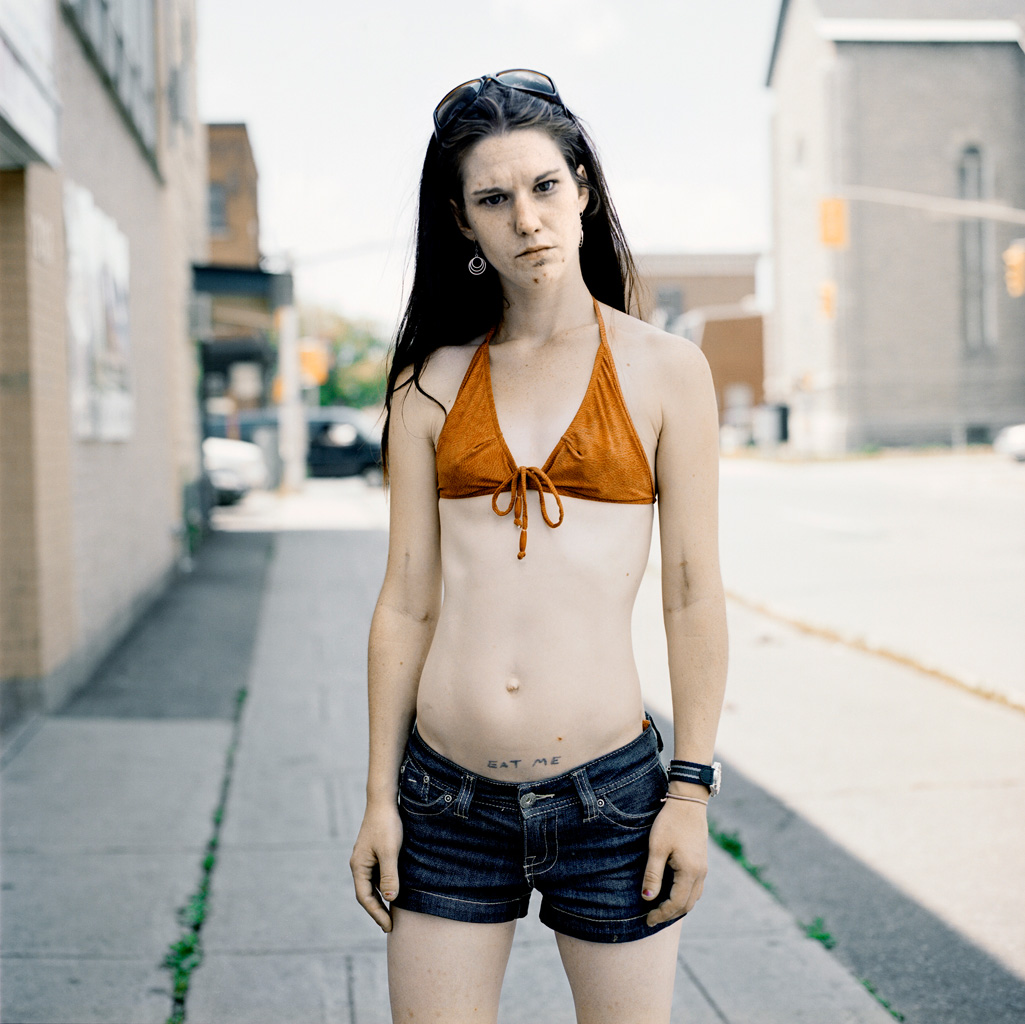
Live Through This is a book created by Canadian photographer Tony Fouhse and young heroin addict Stephanie MacDonald. They met in the street before she got clean – before she wrote this book.

LILA: What do you remember of the day you met Steph?

TONY: I remember that day very well. I had been shooting on the block for another project, USER, for an hour or so when Steph came up to me and asked what I was doing. I told her and she asked me if I would take her picture. I set it up, shot a few frames and knew right away that there was something about her. She was intense but open, transparent, able to get in touch with her feelings and brave enough to show them to me. We talked for a while once we were done and I just felt some kind of connection. I met and photographed her a number of times over the next month or so and finally blurted out the words “Is there something I can do to help you?”.

LILA: …she answered she wanted to get clean and your journey together began. Have you ever thought Steph was not going to live enough to complete Live Through This?

TONY: Yes. When Steph left the hospital (3 days after brain surgery, against medical advise) I was told that she had a 50% chance of dying in the first week. Too, about 4 months ago she relapsed (for a while) and called me up from her hospital bed (we live about 1000 miles apart). Because of her renewed drug use her Hepatitis B was acting up and her liver was failing. She straightened out and seems to be doing okay these days. But every day is a struggle and the future is unwritten.

This is an excerpt of Steph’s writing from Live Through This:

On my first day of school my mom took me and i cried when she first had to say good bye but she told me she would wait out in the hallway so i would feel better! when it was time for me to go out for break i didnt see my mom but by that time i was fitting in with my friends and playing so i didnt really care cause i was having so much fun!!:)

My first memorie of being in Ottawa would have to be walking down to King Edward and seeing how easy it was getting the drugs i needed and seeing how many people all had drug problems!! chris new where i could go to find the block so i could get my pills but he was scared to ask anyone. So i went and asked the first person i seen was noddening out and boom i found my fix. i looked at it as a safe place to live and do drugs without going to jail cause i know in halifax if they see you around a drug place you get searched and booked in jail but not here they just see if your alive.

i was sooo unrealibale I was a horrible friend and i only thought about myself!! as i did it i didnt feel bad at all but once it was done i felt like shit! but when ur a junkie you only think about yourself. Once I herd I was ganna start the program I thought to my self “Can I Do It?” but I had you and i didnt want to let you down and tell you no I wasnt ganna do it. so I new I had to do it and I was scared!! cause drugs was alls i new. But i new it had to be done. deep down i did want to get clean

LILA: Tony, who is Steph, beyond the word drug addict?

TONY: Steph is a bright, sparkly person. She likes to get excited but is also about the laziest person I have ever met. You know how you go through life and meet all these people but only 2 or 3 or 4 of them become real friends? Why is that? Probably has to do with things you can’t really verbalize, don’t even want to. You are just happy to have met someone who you feel real and comfortable with. That’s Steph.

Steph, co-author of Live Through This.

LILA: I’ve never been to Canada. Ottawa, the capital, is ranked one of the highest quality of living city of the world. Funny enough, your pictures/stories of addicts paint Ottawa like the equivalent of Skid Row, in my imagination. How do you perceive your own city?

TONY: Ottawa (or, as I like to call it: Kapital City) is quite parochial with an overhanging odour of bureaucracy. It’s mostly pretty, scenic, even, and safe. But like any tight conglomeration of one million people, it has variety. USER, my photographs of addicts were all shot on one 30 metre strip of sidewalk where this particular society of addicts hangs and conducts business. If you walk 2 block from there you are in a totally bourgeoise, tourist-trap area. Life’s like that.

LILA: On your website I saw a few pictures you took here in LA last year. You clearly have a special focus on the people who lives at the margins of society. Have you ever thought of shooting LA addicts who belong to higher social classes? Maybe for another book ;) .

TONY: Never thought about shooting more addicts. I’m done with drugs.

Interview by Liliana Isella.

Photos by Tony Fouhse

from Live Through This.

LILLY

In POETRY on October 15, 2012 at 2:18 pm

Poem by Liliana Isella.

As I sit alone
in this church

sacred to my heart
is nothing

but your presence.

Poem by Liliana Isella.

Photo by Nikolay Krusser.

EASTER

In LITERARY FICTION on October 1, 2012 at 4:04 pm

Short story by Elizabeth Dunphey.

Goodbye, the kiss off, written on her rich girl blue stationary with the silver hearts.
Easter Horowitz looked like a Zappa girl, a tall JAP-y Zizmore girl, with a prized closet of size seven Jimmy Choos and long black hair.
Snow White, he had called her, on their first date, in Boston.
They were in Cambridge, walking in their red matching rugby sweaters and bantering, as if it was Love Story. He bought her a coffee and quoted Keats: “a thing of beauty is a joy forever . . . .”

The stripping happened after he left her for his grad student, Wendy Flannigan, all of twenty six. Wendy was bright, competent, sandy haired, and funny. She used to type his reports for him, and then one night, during a thunderstorm the power went out.  When it returned, he found her before him in a state of adorable disarray and he kissed her bare shoulder.

You could count on Charlie’s for the lookers, they said.
 Monday night, he went to see Easter dance.
Charlie’s was a beaten exotic dance joint, in South Jersey. The soundtrack: Bruce Springsteen, Marvin Gaye, Radiohead, “Fool to Cry”, “Wild Horses” and “Angie.” It was aching music that always made you think of what you could never have.
The walls were solid gold mirrors. Red velvet benches stained with beer. It reminded him of a basement, some school boy’s dream of what women were like. Some of the girls were rather beautiful, in their homecoming queen way, and it depressed him to see how far women had fallen.

And then his wife came onstage, the prettiest woman in the room.
She had a move, it was “the toss.” She tossed back that raven mane, and gave a big smile to the strange men, who sat with loosened legs.
Philip knew her well, he knew her smile was totally fake. It pained him to watch her this way. He took out a forty and deposited it in the yellow bikini string of the thin blonde who was perched before him, smiling vacuously. The whole place made him sick. He got up to leave, alone, again.

That’s why he wanted to protect Dacey. She was his only daughter.
She was an exceedingly beautiful girl, not just cute or pretty, but superlatively pretty, like her mother, a head-turner with skin like brown butter and ebony hair. Her stumbling block was talking to people other than her protective father.
Dacey was the one who could see through all his professorial bullshit. He often gazed at the brilliant girls in his class, with their heads over their mythology books. He thought to himself, this very intelligent girl may be Dacey in ten years.

“Hey, Knockout,” he whispered, and Dacey looked up from her artwork that night. She was frowning. He tried not to laugh at the expression. Yet, being a sweet girl at root, she did not hurt him back, and her face broke into a small toothed smile.
He gazed at that jet black hair. Fine and perfect. It was her mother’s hair, which fell below her Indian brown collarbone; she’d given Dacey something at least. Silk. She looked like her mother Easter, he decided, studying her in the lamplight. She was growing into something regal and important. But those eyes were different. Easter’s eyes were blue, robin’s egg in some lights; Dacey’s were the dusk brown of roasted nuts. Those eyes would knock some boy out of town someday, he thought proudly – and with a little paternal jealousy.

His family never liked Easter. One, they were Brahmin snobs, tracing their lineage to the Mayflower, a hook nosed clan with the wintry eyes, the proper dishware patterns, and a family seal. Number two, Easter was a flake. A Buddhist.
There she sat at their Christmas table, the year 1987, crossing and uncrossing her long legs at the ancient mahogany table with the tasteful Swarovski chandelier glittering. Easter ran a sweaty hand over her dangly earrings – a nervous gesture (that charmed Philip at the time). She had long nails too, which his bossy sister meanly commented upon.
Easter drank a lot of Merlot wine, and flirted with his tow haired brother Neil. She was just totally uncomfortable with their Gentile ways. She was from the Texas gutter, they said to him – with that gypsy hair and dark skin, from her Cherokee ancestry.  The parents Clyde and Candy intuited something awful, but Philip was blind and he only knew that he loved her, in that moment.

“I’m reading Dosteovsky for Russian lit.” Wendy said softly, one night, making room for him on the couch. “You should read the line up. I can’t pronounce any of the names. I should have taken an Irish class.”
“You are Irish. That would be predictable.” Wendy wrapped an arm around him, and they began to kiss. He was tangled in her embrace, her short sensible gold hair, the scent of dime store Mary Kay perfume. But, he never judged her cheap perfume, it struck him as wholesome, and he knew she was saving for a car.
Then he heard the rigid click clacking of heels, and he was face to face with Easter, with her tanned hand in Dacey’s. It was a touching portrait, he admitted, and his gut did the same slow burn of nostalgia for Easter. The two dark haired girls, Cher and her half breed Pocahontas. Around Easter’s neck was a brilliant ruby necklace, which heaved above her sleeveless red Marc Jacobs dress. She had not bosom at all, which was odd for a stripper. It leant her a kind of fragility though.

“Out. Easter.” – yelped Philip, straightening his shirt, in a panic.
“A mother is a goddam mother and I will sue you,” hissed Easter, glancing at Wendy with a catty look.
Easter’s eyes were something else. So beautiful, so small though, and venemous as a cat. A spooky look, thought Philip, and he felt a glimmer of fear, for the first time in his life.

They went to court. Philip had a better lawyer, but Easter was the victor.
As Philip looked across the room, Easter was dressed soberly. Black dress jacket and a diamond bracelet. She was driving an Arab’s Jag too. She cleaned up, he thought, grimly.

The court offered him weekend visits.
Dacey ran across the room to hug him. They had this minute at least. Dacey wrapped her olive arms tight around his neck. He wanted to capture this moment and he could feel it fading and dying and going away.
He thought of the time he had told her the Greek myth of Midas. He was a professor, he told those kinds of stories. In his opinion, Easter was King Midas.
He knew what would happen. Dacey would grow up. She would remain gloriously beautiful and be even more so. She would get boyfriends, and bring them home to her place. Tatoos, cell phones, texting, myspace, and boys. She would shop at the mall and grow brittle and shallow as an American teenager girl does.

In the light of the setting sun, Easter reminded him of Cher – glamourous, chain smoking, and over-sexed. He knew by nightfall, the ponytail she wore today would have fallen free. Men would cheer her on, in the dark lights, and she would pick one special man to spend the night with. She always did pick one guy, and they weren’t always rich. What she craved was comfort. She liked the physicality of the male.

He found himself staring at her longer than he had wanted to, puzzling over her resemblance to his Dacey.
Easter Horowitz was the first to walk away, taking the court steps two at time, in her tall, Gucci heels. He thought about the funny part, how he had known every detail of her, her hair and her nose, that perfect Roman nose that could have been on a coin one hundred years before. He lit a Marlboro, and paused, day dreaming about the good old days, living in the past that would never come again.

He looked up and his Wendy waved from the car. Her smile was totally transcendent. Her crooked teeth, the freckles, the blonde hair. He thought of the ending of La Dolce Vita. She was something innocent, at least.
He waved back, even if it meant leaving the best thing that had ever happened to him. You had to know when to fold them, went the song. You had to know when to go, and so finally, with the tear on his threadbare seersucker lawyer sleeve, he had left his Easter.
Goodbye, he thought to himself, Easter Horowitz.  I will remember you every day of my life.  I will remember you even when you forget me.

As he walked to the car, he found himself walking quicker, then running, fleeing for his life, running like a deadbeat professor who lost custody and seduced his grad student. He knew what the world saw, and he knew what he was – Easter’s creep ex and nothing more. He was running for his life, but he hoped he was finally going somewhere.

Story by Elizabeth Dunphey.

BUTTERFLY DREAMER

In LITERARY FICTION on September 25, 2012 at 1:39 pm

Short story by Sue Callender.

The nape of her neck expended tears of anxieties and fears.
Recalling love had and love lost – not so appealing, and yet so enticing.
Dalliances craved to the core of pleasure – few and far between.

Her pensamiento turned to him – the boy next door. She once had a dream in which he beguiled her out of her clothes, and she came (in actuality).
Nothing really happened, ‘twas solely the act of perhaps, the chance of maybe, the mere sound of yes.

He had come over to work on their yard a few times; her flat mates said they knew him from school. And every time he would pull out his grandeur shears – skin so smooth, hair so fine, a countenance of soiled dreams entrapped in perfection.
All she could do was grasp her notebook and coffee whilst she sat on the big beautiful cyclical bay window, her foot dangling.

Her corazon went a flame, when her pensamiento turned to him.
Her sentimiento could only be conveyed as the time of the butterflies.
But, their rustling flaps angered her.
Love did not reside within her, anymore.

All too real – imprecations of past existences have brought her here. To this place of sullied Nirvana. Cobain-ing through life, the misery felt so right. The happiness felt so raw, so transient, so self-important.
She hated that happiness. And it was more clear than the crystal that resides in the tomb of Great Love:  Happiness hated her as well.
And this actualization paralyzed her, breath heavy and oscillating against the big beautiful bay window.
A dream deferred.

Story by Sue Callender.

Photo: Girl and Butterfly.

ALEPPO

In POETRY on September 10, 2012 at 3:03 pm

Poesia di Maurizio Pedrini.

Gli incubi della notte
sono incredibilmente vivi
mentre la pioggia di bombe
s’abbatte su scheletriche case.
Aleppo m’appare illuminata
dai lampi del temporale
che rinfrescano il mattino
mentre ancora dorme Verona.
Gli infami orrori della guerra
s’affollano nella mente
evocando solo inutili morti
follie distruttive d’ogni cosa.
Rosse lacrime di sangue
colorano le vesti delle madri
prostrate al capezzale
di piccoli angeli smembrati.
Mi risveglio infinitamente stremato
dalla bastarda violenza assassina
stanco dello stupido potere
che giustifica solo se stesso.
Per questo ancora ti prego, mio Dio,
con la forza della fede e della ragione
ultimo appiglio per il mondo
in questo disperato spasmo
di fuggevole speranza.
Perché solo il miracolo della tua voce
potrebbe domare, come d’incanto,
la barbarie di questi oscuri giorni
che, implacabile, massacra
ogni residuo d’umanità.
Vorrei finalmente assaporare
un soffio di dolce armonia
il fresco piacere di nuovi giorni
il tempo d’un amore senza confini
vittorioso sull’arroganza
sulle assurde ideologie
sui pregiudizi di sesso e colore
sul fanatismo religioso
che certo non tollera
chi ti ama in modo diverso.
Non desidero effimeri beni
illusioni di dannate ricchezze
ma solo essenza d’amore.
Così ramingo viaggio
senza sterili barriere
dentro l’universo dell’anima
alla ricerca di me stesso.
Torno rassegnato a dormire
mentre nel sogno risplendono le luci
del mio risveglio in un mondo di pace.

Poesia di Maurizio Pedrini.

Immagine di Rene Magritte, The Great War (1964).

APOLLONIA

In LITERARY FICTION on August 21, 2012 at 2:53 pm

Short story by Elizabeth Dunphey.

Celebrity Picture: Bebe Buell - Bebe Buell Picture

Apollonia was pretty, in the American way, which never changed, even when she hit thirty-nine.
It was a look as resilient as America itself. She had blonde hair, a gummy smile and white teeth.
At the high school reunion, everyone remarked upon her youth.

When she was born, her father held her and stared into her small Asiatic blue eyes, and said aloud to anyone who would look, “What should I name my little apple? That’s it. Apple!” And so they did.

They lived in Iowa. There was a white frothy fountain in the center of town and a few Chinese restaurants, a blossoming writer scene and she liked to go to the coffeehouse.
Mostly she wrote tales in the style of Anais Nin, her favorite writer. She had all her diaries.

The Midwest boys found her early. Like the Tom Petty song. A good lookin’ girl, with a good lookin’ mama.
The boys had all seen Apple’s mom, Cindy Hansson, leaning over the garden, her bleached hair over one, kohl lined eye. She had an almost slatternly kind of beauty, which wooed the local truckers.
You never wanted to think of Apple turning out that way though.

Whether it was the art boys or the jocks or a science teacher asking her to stay late, it was a man who could make Apple’s life start.

In the winter, she washed her hair with Revlon, in the shade Dark Black. Her real hair was honey, but she liked it dark because it reminded her of Morticia Adams, and even if she was good, she wanted to be bad.

One boy named Raymond wanted to kill himself for her. They put him away in a hospital after she said clearly at her locker, balancing all her slim weight on one foot, with her Swedish sureness: “No, I do not love you.”
And you had to have shred of respect for a woman like that.

She went from one to another; the numbers kept piling up, she was collecting them, these healthy boys.
And, she had forgotten how judgmental people could be about loose girls like that.

Once school began, she fell in with the art kids.
She went from the preppies, to the pure dirt of the dark side.
Maybe that was why she dyed all that pretty blonde hair, and horrified her mama.

She was a fine artist, and wanted to study at RISD.

Her boyfriend Lance painted her picture.
It was a Salvador Dali knockoff.

He slid his hands under her blouse, and unhooked her bra.
“I want to see you that way,” he said. “I want to see you the way God made you. The way you will look in heaven.”

Her Republican ways were falling away.

Lance wrapped his arm around her to warm her in the cold.
They were standing outside a deli.
His girls in the crew despised Appolonia. They had tattoos along their breast.

“Don’t be nervous.” He kept saying. “You’re pretty, that’s enough.”

One night, we found her crying.
It was a hot summery night by now; the seasons had passed, the fields of wheat were being cleared and the farmers were out, wiping sweat from their brow.
It was the stickiness you find in July and her thin lips were the color of bubble gum.
Time was marked by Apple’s turtlenecks, then her halter tops, her cutoffs, and now she wore a simple Charlie’s Angels t-shirt.

She was holed up in the backseat of the car and wouldn’t leave.
A boy had just slept with her. We could tell, because her lipstick was smeared. It was an echo, however faint, of her mother’s looks.
She had stopped dying her hair that night, so it was blonde again, violently beautiful and soft against a tan shoulder.

“Wouldn’t it be different if he was here?”

“Who, Apollonia?”

“My father. Oh, my father had to die. It’s so stupid. But everything comes back to him. Did I ever tell you he was a lawyer? He was very successful.”

We left her there, crying.
No one knew what to do with her. We left her.
Even Lance left her. Madeline’s idea. “Let the spoiled little slut cry,” she laughed.
It was cruel, because they were cruel kids.

Another night, she tried pot.
The boys loved that night, because she was even flirtier and easier than before.
Being artists, they saw something that a simple man would not see. If they toyed with her, you couldn’t blame them. Maybe they were jealous of her too; this normal girl stranded among the wicked sun coming through a windy rain Iowa field day.

She left the town for RISD.
She gathered up all of her portfolio, packed her nice clothes, and collected all of her photos. She studied one of them. It was a picture of her and Madeline, the goth queen, and Lance. She knew that the year with these kids was going to fade away. It would be a memory, with no more power than the first boy Raymond who had held her hand and told her that he loved her. No power, no memory, nothing.

The only thing that lasted was her father, her Atticus Finch. That lasted.

She folded her clothes and brushed her light hair, while her mother cooked dinner, smoked her cigarette, and talked on the phone.
Apple stayed upstairs, thinking of the men who would find her in college and the power that being pretty brought to a girl, while it lasted.

Story by Elizabeth Dunphey.

Photo: Bebe Buell.

LO SPAZZINO DELLE NUVOLE

In DRAGONFLY IN THE NIGHT by Benedetta Tagliaferri on July 9, 2012 at 4:26 pm

Storia di Benedetta Tagliaferri.

Photobucket

C’era una volta uno spazzino, di quelli come ce n’erano una volta.
Vestito di blu, berretto in tinta, taciturno ed immerso nel suo metodico movimento.

Spazzino adorava il suo lavoro; lo definiva leggero e celestiale.
Ed aveva ragione, perché erano le nuvole nel cielo blu che doveva spazzare.

Era stato scelto dall’Aldea Blu per rimuovere dal suo manto azzurro le bianche nubi, che ai suoi abitanti parevano invadere inutilmente l’orizzonte, nascondendone i limiti.
Gente strana.

Ma, effettivamente, il loro cielo era ampio, pulito, brillante, e loro allegri e felici.
Sopratutto durante i tramonti estivi, era una tale bellezza vedere tutto il mondo circondato da raggi limpidi, colori incandescenti e ammirare il sole addentrarsi nella notte, altrettanto limpida.

Ma, ció a cui non avevano pensato gli abitanti dell’Aldea Blu, era che le nuvole che spazzino spazzava via si accumulavano su un’altra aldea, che non sapeva perché il suo cielo era sempre grigio e pieno di nuvoloni, tutti accatastati uno sull’altro, gravidi di perenne pioggia, minacciosi di tormenta.
E gli abitanti sempre tristoni, demoralizzati.

Non sapendo come fare per liberarsi di tale cielo, il capo dell’altra aldea decise di inviare in spedizione tre cittadini coraggiosi a cercare un altro tetto sotto il quale traslocare.
I tre viaggiatori camminarono per praterie impantanate ed uggiose per ore ed ore, fino a che il cammino si fece sempre piú secco e caloroso e dal cielo iniziarono a trapassare raggi di sole, tra nuvole sempre piú bianche e dissipate.

Felici ed entusiasti continuarono a camminare in quella direzione, galvanizzati dalla scoperta di un nuovo cielo sotto il quale vivere sereni.

Tutt’un tratto, peró, videro un ometto su una scala lassú, con una scopa in mano, che fischiettando rimuoveva le poche nuvole verso la loro lontana casa.
Allora capirono tutto, e si arrabbiarono non poco!

Spiarono i vicini e li videro godersi un cielo eternamente limpido e luminoso, mentre il loro li faceva vivere sempre inzuppati ed arrabbiati.
E tutto a causa di spazzino che spazzava le nubi sempre e solo verso il loro villaggio!

Tornarono e raccontarono tutto al capo, che decise di riunirsi con gli abitanti dell’Aldea Blu per risolvere la questione.
Ma non ci fu nulla da fare; l’Aldea Blu ad un cielo limpido non voleva rinunciare.
Cosicché iniziarono a litigare.

Un bimbo, tutt’un tratto, chiese di parlare.
Il bimbo spiegó che, a tutti loro non adulti, piace giocare.
E, uno dei giochi piú divertenti da fare, é saltare sulle nuvole soffici, farne delle formine e gli animali inventare.

Tutti conclusero che, effettivamente, d’ora in poi sarebbe stato meglio lasciare a spazzino la libertá di spargere le nuvole a suo piacimento, affinché i bimbi di ambedue i villaggi potessero godere di un parco giochi soffice e leggero, facile da spostare.

E spazzino si dispose a spazzare.
Aveva il lavoro piú felice e leggero del mondo: mandare verso il basso i nuvoloni pesanti, cosicché i bimbi ci potevano saltar sú e fare le capriole, e disporre un recinto per quelle piú inafferrabili lassú, cosicché potevano agguantarle e trasformarle in tutti gli animali che erano capaci di immaginare.

Storia di Benedetta Tagliaferri.

Arte di Sergio Leta, Cosa sono le nuvole.

WAITER

In LITERARY FICTION on March 14, 2012 at 4:58 pm

Short story by Jon Dambacher.

He justifies the older black and white headshots by dropping trade paper quotes about such and such casting director, “…prefers black’n white because they’re more classic.”

He shot photos of himself in the bathroom when he first got to town but now is too lazy to drop the weight while eating a salad with the dressing on the side, which he pours on.

The Whole Foods vegan cookies and sugar-free brownies are his favorite.
He sits in his apartment scrolling through the online casting calls.
Soon he starts flipping through the local celebrity gossip pages more and more. He used to scoff at them when out to lunch with a girlfriend by saying, “Did you see what Monica Reed did at Razor Blades last night?”
“Oh, god,” she’d grunt before chewing into her soyrizo breakfast burrito, “What’d she do?”
“Well….”
But, he’s slowly become apart of it.

In another conversation the girlfriend asks, “You did theatre in New York. Do you think theatre is dead?”
Moments like these are the closest thing he’s ever going to get to being interviewed. Moments like these keep him alive.
Before answering he leans back into the café booth, darts his eyebrow muscles to really develop a response, “Um, no, I don’t think it’s dead, I just think…”
These talks will be the last fragment of genuine happiness.

The hand-delivered trade papers start pilling up on the driveway at 5am.
The casting websites are all minimized at the bottom of his computer screen to be looked at this weekend.
Celebrity news is flipped through zombie-like while he’s at the store waiting to be asked to decide between paper or plastic for his frozen pizza. On a much smaller scale, this question is also treated as part of the extended interview. Considering he’s a role model for Americans everywhere he wants to send a good message, “Ah, you know what, I don’t need a bag. Save a tree.”

He goes to sleep early and wakes up late.
He’s the most famous person living in his apartment building. Everyone invites him to their courtyard birthday barbeques.  Everyone removes their ear-buds when they’re in the laundry room together to say, “Hey.”
They’re all casual about it, which he really appreciates.
Word got out about him being a connected industry guy after he was leaving self-addressed Warner Bros. postcards in the communal junk mail bin.
Manila envelopes which contained Screen Actors Guild magazine subscription information began to stick out further than all the other trash. If ever a package came, either the Superman themed remote control or the Planet Hollywood t-shirt from eBay, it stayed on the doorstep of Room 3 for days before someone finally mentioned it when sliding quarters into the dryer, “Hey, I grabbed a package for you that came. It was left for a while out in the hall. I think you were out of town or something. I’ll bring it right now.”
“Oh,” he says, shrugging his shoulders ever so delicately, “…yeah, I was. Got sent to Europe for this thing.”
It feels so good. “Thanks for grabbing it, though.”
“No worries,” she says, shrugging her shoulders with simulated comfort. “I know you’re busy.”
He chuckles.
She nods, “Oh, I understand. Believe me.” She begins sharing, “With this new deal at work I’m….” And he stops listening.

When she finally leaves him there, alone in the laundry room, he stacks quarters into fours, creating small towers, calculating each dollar to the amount of his load.

His job keeps his mind there in the entertainment world, as he’s waiting tables off the Walk of Fame under the feet of Hollywood Boulevard.
Every morning as he steps into work he’s joining his fellow cast members. “Hi, welcome to the World Famous Fab-Fifties joint.  Our special today is the James Dean burger with Marilyn fries. With our World Famous Shakes you’ve got some options: Bing and Bob, strawberry banana, or do a solid and get the peanut butter chocolate which is the Bella and Boris.”
There is great satisfaction that floods his face when he gets a younger group of people and uneducated table who ask, “Who is the Bing and Bob” or “Bella and Boris milkshake named after?”
He read his lines so cleverly and never misses a cue: “They’re legends.”

Collecting his few dollar tips he smokes cheap cigarettes out back watching the Star Waggons lining the street.
This is a reminder to lose those thirty pounds for updated headshots. He sees those new headshots being taped up to quark boards inside the wagons of the costumer’s trailer; lines of outfits with his headshot copied above the collar; his latest headshot next to his many wigs in the makeup trailer.
Every foot under Hollywood, having come from near and far, has lined up – all faces looking inward – to get a glimpse of him emerging from his trailer, walking into the camera’s focus as someone asks him, please, to do what he is known best for all around the world:  singer/songwriter, actor, writer/director/producer, author, entrepreneur, and social media consultant.

The black and white headshot falls to the carpet of the trailer floor turning to dust.
The cardboard cutout wilts to ash, blowing away in the smog up over the Forest Lawn Mountains.
He flicks his cigarette into the street, turns his back to the sun and returns to drop off Table 53’s tuna melt and fries with a side of ranch.

Story by Jon Dambacher.

Photo by Unknown Author.

MARY GARRET

In INTER-REVIEWS on February 9, 2012 at 4:06 pm

Interview with ballerina Mariafrancesca Garritano.

Mariafrancesca Garritano, known as Mary Garret, is a thirty-three year old Italian ballerina who has spent seventeen years at La Scala Theatre in Milan, where she was recently promoted soloist. Last month she has been fired because of some inconvenient truths – such as her struggle with anorexia – she has revealed in her biography.

LILA: Hi Mary. How was your day?

MARY: I woke up, took ballet class and rehearsed a piece I’ll perform as guest artist in Salerno, a lovely town in the south of Italy.

LILA: Since you lost your job at La Scala in the past days, do you still have the same ballet routine?

MARY: Yes, I take regular class every morning and then study variations and pas de deux. I’m back to tip-tap as well, which is something I used to love and do much more when I was little.

LILA: To breathe is not a choice. Being a ballerina is a choice or a lack of choice?

MARY: I’m still wondering… sooner or later I’ll get an answer! 

LILA: You entered the La Scala Theatre Ballet School when you were already sixteen. How did that happen?

MARY: I auditioned – the audition was a ballet class – and I passed it. Then, after one month trial, they confirmed me.

LILA: You’re from Calabria, a region from the very south of Italy. I was there for a beauty contest back in 1997 and, being a girl from Milan, I was scared. How was leaving your family down there and moving to Milan?

MARY: At the beginning it was hard but the excitement of making my ballerina dreams come true by studying at La Scala didn’t make me feel the loneliness. I’ve always been a dreamer and all I was looking at was my future of endless possibilities. 

LILA: How have both Milano and Calabria changed along these two decades?

MARY: Calabria is a land of stubborn people, which can be a good thing and a bad thing. I don’t go there a lot but, when I do, my memories don’t match the reality of the present anymore. There are still many young people who leave but many others stay and fight to change it into a better place. As of Milan, I have been involved so much in the ballet world that only recently I actually got to know it more. Milan runs fast to keep up with its tourism, fashion, arts and business. Milan has also slowly become a multiethnic city and that has changed its identity a lot.

LILA: What’s the spiritual feature that makes of Mary a ballerina?

MARY: The unconditional trust in what I feel deep inside.

LILA: What about the psychological one?

MARY: Willpower, which sometimes is a great engine to keep up with the exhausting work but, some other times, interferes with my ability to learn and grow!!!

LILA: And the physical one?

MARY: None really. I am not one of those ballerinas with great physical assets. But, the lack of them didn’t keep me from becoming one. Nothing more than your own brain can be your biggest physical challenge. At the same time, you become a ballerina because you have strong brain and heart that co-operate in developing and expressing the artist in you.

LILA: What ballet character do you feel the closest to who you are?

MARY: Clara in The Nutcracker by Rudolf Nureyev, as she represents the metamorphosis of a dreamy teenager into an adult. 

LILA: Which one you love performing the most?

MARY: Odette/Odile in Swan Lake by Nureyev, which is my favorite ballet.

LILA: And the one you liked the least?

MARY: I don’t remember one I didn’t like. 

LILA: Any character you didn’t perform yet and dream about?

MARY: Sleeping Beauty is one of my preferred ballets; I danced the role of Aurora only in a little excerpt – the pas de deux in the third act. Well, probably I’d like to dance the whole part of Aurora, from beginning to end. But, so far, I also feel very lucky for all the marvelous characters I already had the possibility to be on stage! 

LILA: Before writing your biography, did you like writing? And reading?

MARY: I always liked writing; as a child I was already writing fictional stories and thoughts about life. I also read a lot: psychological essays, Zafon and Oriana Fallaci. 

LILA: From what feelings your book, La verita’, vi prego, sulla danza, came from?

MARY: From the desire to reflect upon the human being inside the ballet dancer. Every artist feels the moral necessity to do so, at some point, and find her/his truths in her/his heart. 

LILA: How do you live your body and your femininity today compared to sixteen years ago?

MARY: Even sixteen years ago I didn’t feel that trying to be thinner and thinner was normal. As of today I know I damaged myself but I’ve also learnt that, no matter what’s going wrong, you can always turn it around. And, that’s the message I hope to send out through my biography.

LILA: Who’s ballet for?

MARY: For everybody. At the studio I practice lately there’s a dear friend of mine, a seventy year old woman, who practices next to me at the barre. Dancing is something that has always belonged to the human spirit and it should be available to everybody.  

LILA: What’s easier: a partnership with a man on stage or in real life?

MARY: For me both relationships are easy when I am myself and follow my instinct. Abnegation, trust, acceptance and awareness of each other’s role in the relationship should help the relationship work as well.
 
LILA: Massimo Murru o Roberto Bolle? ;)

MARY: Gene Kelly FOREVER! ;-)

LILA: Can a pregnancy be a threat to the strength and the flexibility of a ballerina? Any personal plan about it?

MARY: Many ballerinas have perfectly continued their careers after pregnancies. Of course you have to be careful and pick the right timing. I didn’t think about it yet.

LILA: What do Russian ballerinas have more than Italians and vice versa?

MARY: Russian ballerinas have great technical skills they acquire early in the ballet academy. Those, with the natural emotional artistry of the Italians, would make the perfect ballerina type. For sure, what we have in common is a total dedication to ballet; I’d love us to invest this same dedication to improve the ballet world also under the human point of view, including the battle to eating disorders, for example.

LILA: Did you expect La Scala to fire you?

MARY: I felt like it could have happened. 

LILA: In your future you see more hopes or fears?

MARY: Hopes.

LILA: What and who will you miss the most from La Scala?

MARY: I’ll always carry everything and everybody inside, good or bad, because that’s a part of me…  and, whomever there is really close to me will stay with me anyways, I believe.

LILA: What company would you like to work with now? In Italy or abroad, as your nickname might suggest?

MARY: I’d love to work in America! I had a chance to move there when I was twenty-one, but I decided to stay with La Scala because I love my country. Today, who knows… I’ll start looking for a new ballet company to join and, hopefully, the Universe will send me something good!

Best of Luck to this beautiful ballerina from all of us!

Intervista di Liliana Isella.                   

Foto di Marco Brescia/La Scala.

Follow

Get every new post delivered to your Inbox.

%d bloggers like this: